


Coffee is part of daily life for many people, yet questions about its effects on brain fog are common. Current evidence suggests that coffee can contribute to brain fog for some individuals, but the effect is not universal and depends on dose, timing, and personal sensitivity.
In this context, whether coffee can cause brain fog is best understood as a conditional question rather than a simple yes-or-no. Caffeine affects attention, sleep regulation, and the stress response, potentially reducing mental clarity in certain situations.
The sections below explain how this happens and when coffee is unlikely to be the main factor.
This article is written as a neutral educational explainer, following general clinical review principles similar to those used in neuroscience education. One example of this educational approach is SensIQ, which focuses on explaining how brain function relates to everyday cognitive experiences.
With input from medical experts such as Dr. Luke Barr, the aim is to clarify mechanisms and limitations rather than offer treatment or guarantees. The goal is to support informed understanding, not to direct health decisions.
Key Takeaways
- Coffee can contribute to brain fog for some people, but its effects vary based on individual sensitivity, timing of intake, sleep quality, and stress levels.
- Caffeine affects mental clarity by blocking adenosine receptors, which can increase short-term alertness but may reduce cognitive efficiency when sleep or stress is already disrupted.
- Brain fog may also occur during caffeine withdrawal, as the brain adjusts to changes in adenosine signaling, and these effects are usually temporary.
- Brain fog is a descriptive symptom, not a diagnosis, and it can reflect a range of influences beyond coffee, including chronic fatigue, sleep problems, medications, or hormonal changes.
- Reducing or stopping coffee does not always resolve brain fog, so persistent cognitive symptoms may signal broader factors that warrant a more comprehensive evaluation.
Is coffee causing my brain fog?
Many people notice mental sluggishness after a cup of coffee and wonder whether caffeine is to blame. Coffee does not affect everyone the same way, and brain fog often has more than one contributing factor.
For some individuals, caffeine intake may align with difficulty concentrating, slowed thinking, or a sense of reduced clarity. For others, coffee improves alertness without a noticeable downside.
Patterns matter more than single moments.
Looking at patterns over time provides more insight than focusing on one episode. Brain fog that appears after repeated caffeine use, poor sleep, or elevated stress may reflect interaction effects rather than a direct cause.
In these cases, coffee can contribute to brain fog by amplifying existing strain on attention systems. This distinction is important because removing coffee alone does not always resolve symptoms.
It can also be helpful to consider context. Mental clarity often fluctuates based on workload, emotional stress, and sleep debt. When these factors are present, caffeine may intensify underlying fatigue rather than correct it. This is why some people feel worse after coffee on already demanding days.
How coffee affects mental clarity
Caffeine stimulates the central nervous system by altering chemical signaling in the brain. Its primary mechanism involves blocking adenosine receptors, which generally promote sleepiness and mental slowing.
When these receptors are blocked, alertness increases in the short term, but sustained stimulation may reduce cognitive efficiency for some people¹. Over time, this can feel like mental fatigue rather than improved focus.
Dose and timing of caffeine intake
The amount and timing of caffeine intake shape its effects. A single cup of coffee in the morning often feels different from repeated intake across the day.
Late-day caffeine can interfere with sleep quality, even if a person falls asleep without difficulty². Reduced restorative sleep may then appear the next day as difficulty concentrating or slower thinking.
Moderate caffeine intake earlier in the day is less likely to disrupt sleep. However, sensitivity varies widely. Some people experience sleep disruption even with small amounts consumed in the afternoon, while others notice little effect.
Why does coffee give brain fog to some people?
Individual differences play a significant role. Genetic variation affects how quickly caffeine is metabolized, thereby altering how long it acts in the brain.
Slow metabolizers may experience prolonged stimulation followed by cognitive fatigue, while fast metabolizers may notice fewer effects. These differences help explain why coffee gives brain fog for some people but not others.
Baseline health also matters. People experiencing chronic fatigue, high stress, or irregular sleep may respond differently to caffeine. In these cases, stimulation can feel overwhelming rather than helpful.
Black coffee and brain fog sensitivity
Some people assume black coffee is less likely to cause problems because it contains no sugar or additives. While removing sweeteners may reduce blood sugar swings, caffeine itself still affects brain signaling. For individuals with higher sensitivity, even black coffee can trigger jitteriness, mental fatigue, or reduced focus.
Sensitivity can change over time. Illness, stress, aging, or hormonal shifts can alter how the body processes caffeine. This explains why a routine that once supported alertness may later feel disruptive.
Sleep and stress effects
Sleep plays a central role in cognitive clarity. Caffeine consumed too late in the day can delay deep sleep stages, which are essential for memory consolidation and attention².
Chronic stress can amplify this effect by increasing baseline arousal. Together, reduced sleep quality and stress can make caffeine’s stimulating effects feel counterproductive rather than helpful.
Brain fog from caffeine withdrawal
Brain fog does not only occur with caffeine use. It can also happen when caffeine intake is suddenly stopped. Brain fog from caffeine withdrawal reflects temporary changes in brain signaling as adenosine activity rebounds³. During this adjustment period, people may feel mentally slowed or exhausted.
How long does withdrawal-related fog last?
Withdrawal symptoms often begin within one to two days after stopping caffeine. They may include headache, reduced focus, and low energy. These effects are usually short-lived and improve as the brain adapts³. Gradual reduction in caffeine intake may lessen intensity, though individual responses vary.
What brain fog actually means

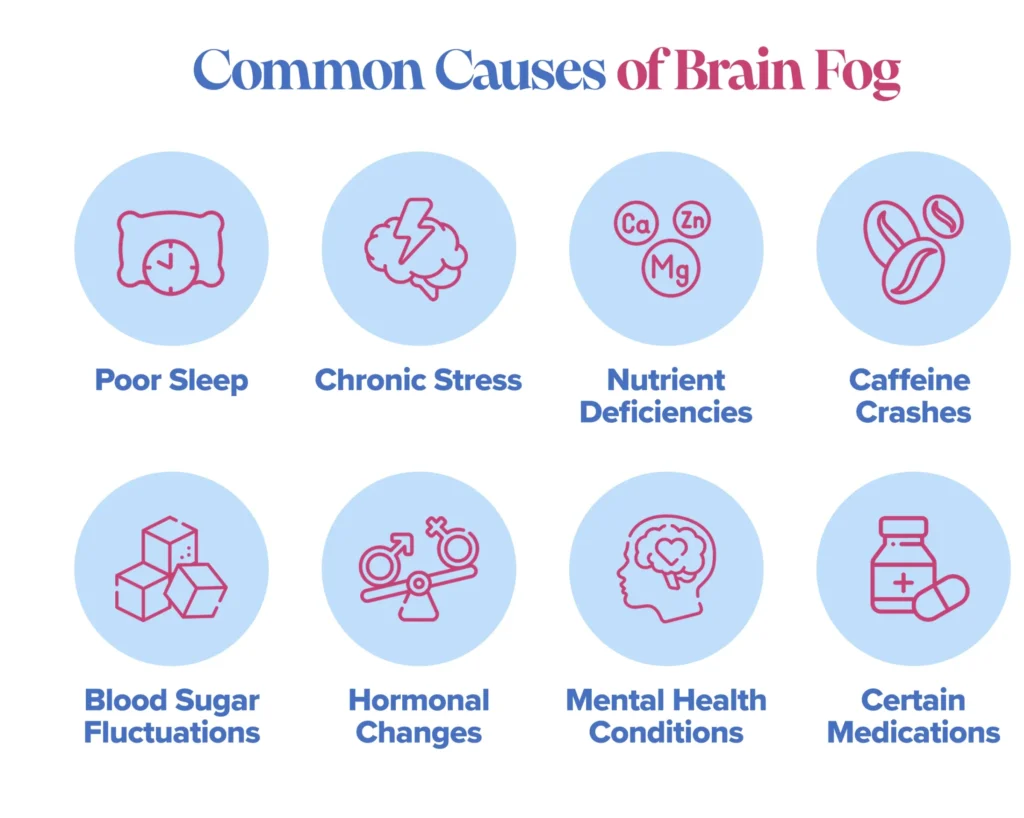
Brain fog is a descriptive term rather than a medical diagnosis. It refers to a set of cognitive experiences that affect mental clarity and efficiency, as explained in this detailed overview of common causes of brain fog.
Common descriptions include trouble concentrating, slower thinking, or difficulty recalling information. The symptoms of brain fog can range from mild distraction to noticeable interference with daily tasks.
Common cognitive symptoms
People often report the following experiences:
- Difficulty sustaining attention
- Slower information processing
- Reduced working memory
- Mental fatigue or low motivation
These symptoms often fluctuate throughout the day and may improve with rest or reduced stress.
Why brain fog is not a diagnosis
Because brain fog describes a symptom pattern rather than a disease, it does not point to a single cause. It can appear alongside conditions such as chronic fatigue, mood disorders, or sleep disorders.
Some medications also list cognitive dullness as a side effect. Clinical evaluation focuses on identifying contributing factors rather than treating the label itself.
When brain fog is not about coffee
It is essential to recognize when coffee is unlikely to be the primary driver of cognitive symptoms. Many people reduce caffeine and notice little change in mental clarity. In these cases, other factors deserve attention. Assuming coffee is the sole cause can delay understanding the real issue.
Hormonal transitions like perimenopause
Hormonal transitions, including perimenopause, can influence attention, memory, and emotional regulation. Fluctuating estrogen levels affect neurotransmitter systems involved in cognition.
During this period, some women notice increased sensitivity to caffeine, while others experience brain fog regardless of intake. Coffee may worsen symptoms, but it is rarely the underlying cause.
Stress and health-related factors
Chronic stress directly affects cognitive performance. Elevated stress hormones can impair working memory and focus over time.
Health conditions such as anxiety disorders, sleep apnea, or inflammatory illnesses can also reduce mental clarity, and some readers explore adaptogenic approaches like ashwagandha for brain fog as part of broader stress management discussions.
In these situations, coffee may play a minor role compared to broader influences on brain health.
Medication effects also matter. Some drugs list cognitive slowing as a side effect, which may be mistaken for caffeine-related fog, while other conditions, such as high blood pressure can also cause brain fog in some instances.
Understanding these possibilities supports informed discussion with a healthcare professional rather than attributing symptoms solely to caffeine.*
References
- Fredholm BB, Bättig K, Holmén J, Nehlig A, Zvartau EE. Actions of caffeine in the brain with special reference to factors that contribute to its widespread use. Pharmacol Rev. (1999) Mar;51(1):83-133. https://pubmed.ncbi.nlm.nih.gov/10049999/
- Roehrs T, Roth T. Caffeine: sleep and daytime sleepiness. Sleep Med Rev. (2008) Apr;12(2):153-62. doi: 10.1016/j.smrv.2007.07.004. https://pubmed.ncbi.nlm.nih.gov/17950009/
- Juliano LM, Griffiths RR. A critical review of caffeine withdrawal: empirical validation of symptoms and signs, incidence, severity, and associated features. Psychopharmacology (Berl). (2004) Oct;176(1):1-29. doi: 10.1007/s00213-004-2000-x. https://pubmed.ncbi.nlm.nih.gov/15448977/
*These statements have not been evaluated by the Food and Drug Administration. This product is not intended to diagnose, treat, cure, or prevent any disease.